Managing Data Integrity in Asynchronous Financial Document Processing
Reliable financial document processing requires a multi-layered validation strategy that decouples raw data extraction from business-logic verification to prevent silent data corruption in distributed systems.
The Illusion of Extraction Accuracy
In high-volume financial document processing, a common architectural trap is the assumption that an Optical Character Recognition (OCR) engine’s confidence score is a proxy for semantic validity. When an automated system extracts data from an invoice or a bank statement, it returns a structured representation of the visual input. If the engine reports a 98% confidence score, engineers often treat that data as "truth" and pass it directly to the core ledger or reconciliation engine.
This is a dangerous misconception. A high-confidence extraction is merely a high-confidence transcription of pixels into characters. It does not guarantee that the resulting data makes sense within the context of the business domain. For instance, an OCR engine might perfectly transcribe a date as "31/02/2024." The engine is confident because the characters are clear, but the date is semantically invalid. When this data hits the ledger, it triggers a downstream failure, often requiring manual intervention or, worse, causing silent corruption if the system lacks strict schema enforcement.
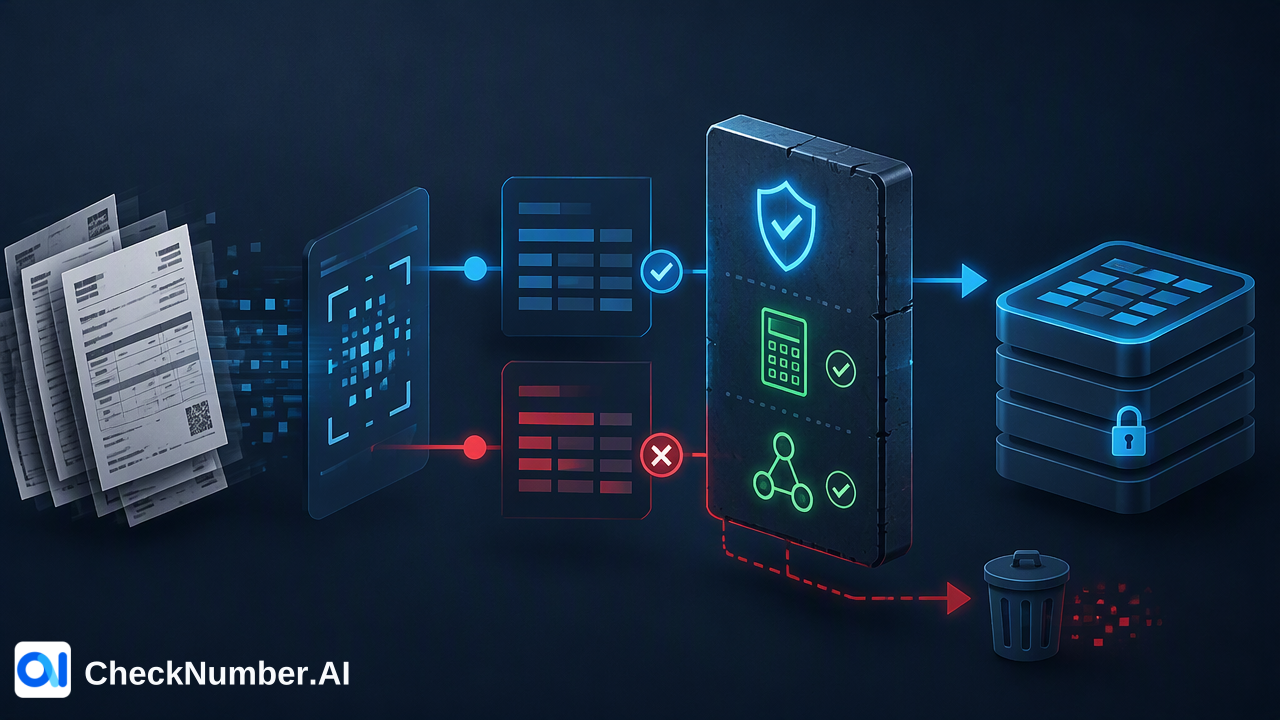
The Multi-Layered Validation Strategy
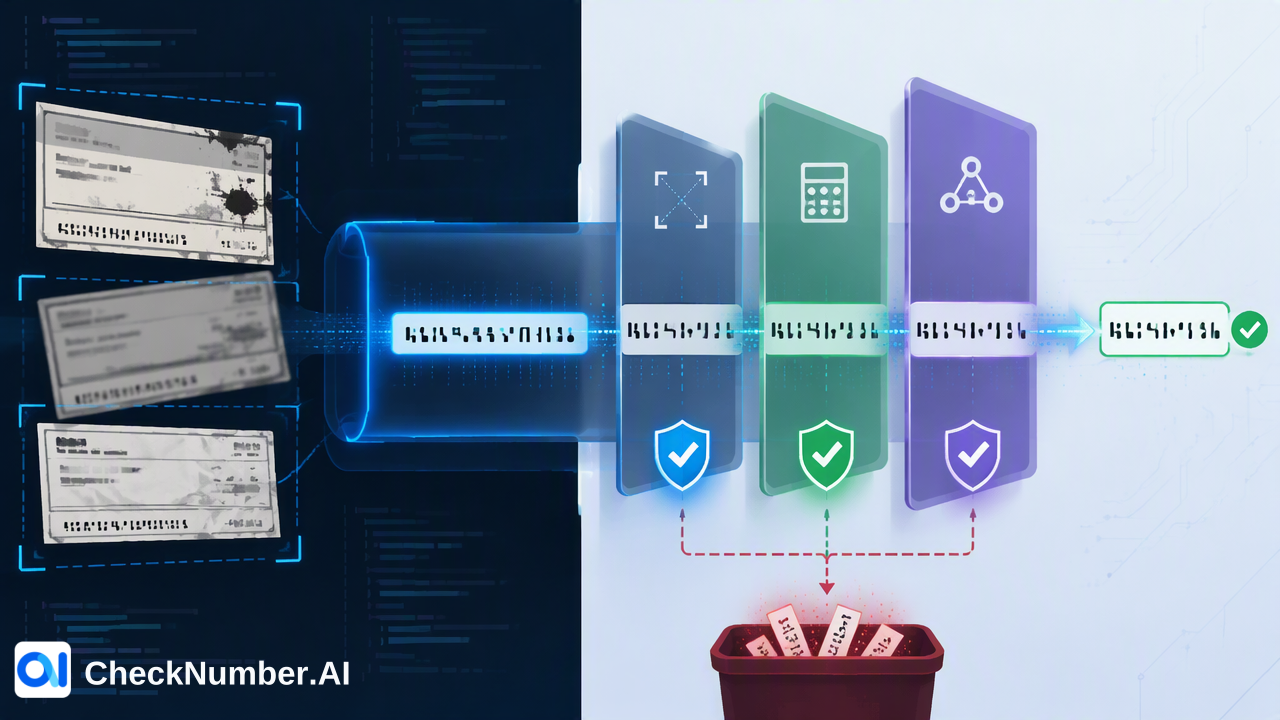
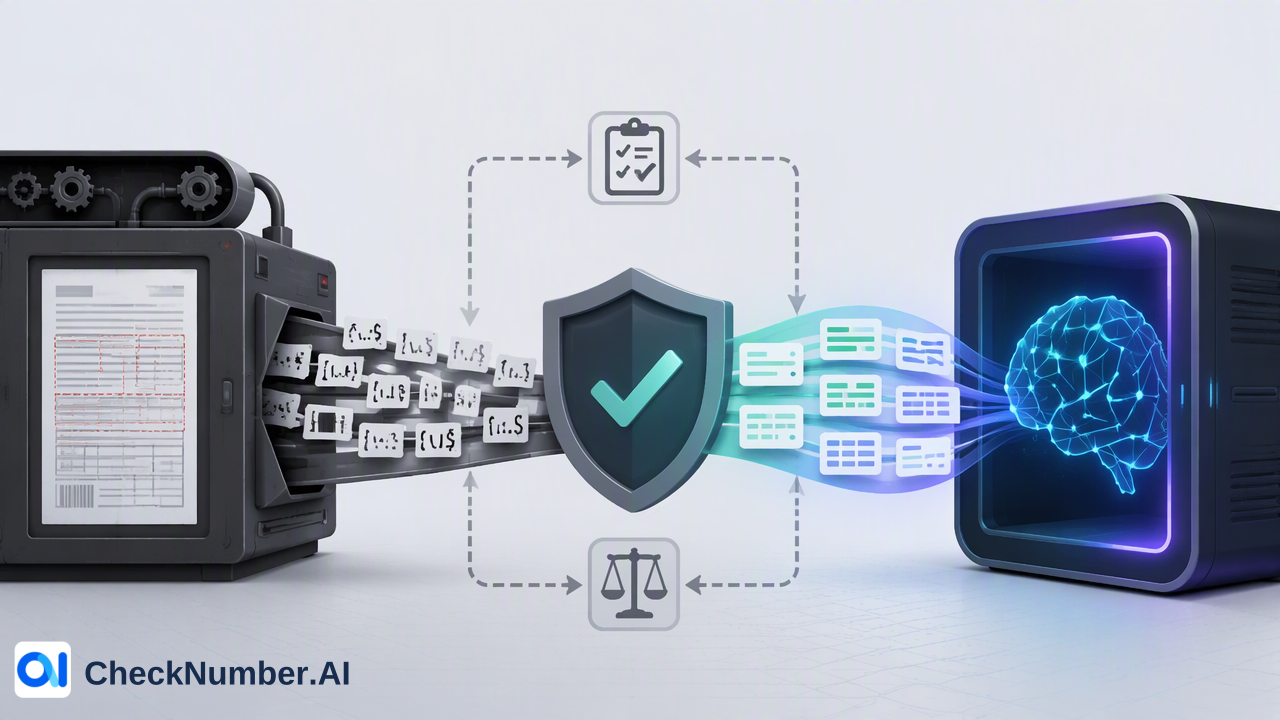
To prevent these failures, we must decouple raw data extraction from business-logic verification. The architecture should treat the OCR output as "untrusted input" that must pass through a validation middleware before it is ever considered for persistence.
Layer 1: Deterministic Checksum Validation
Financial documents often contain identifiers that follow specific mathematical rules. Bank account numbers, routing numbers, and tax identification numbers frequently include a check digit calculated via algorithms like the Luhn algorithm or Modulo 11.
Before performing any complex business logic, the middleware should run these deterministic checks. If an extracted account number fails its checksum, the system should reject the document immediately, regardless of the OCR confidence score.
def validate_luhn(account_number: str) -> bool:
    # Implementation of Luhn algorithm to verify checksum
    digits = [int(d) for d in account_number]
    checksum = digits[-1]
    payload = digits[:-1][::-1]

    total = 0
    for i, digit in enumerate(payload):
        if i % 2 == 0:
            digit *= 2
            if digit > 9:
                digit -= 9
        total += digit

    return (total + checksum) % 10 == 0
Layer 2: Cross-Field Consistency Checks
Once the individual fields pass basic format validation, the middleware must verify the relationship between fields. This is where most silent corruption occurs. A common example is the "Total Amount" field. If an invoice lists three line items, the sum of those items must equal the total amount.
If the OCR engine extracts the line items correctly but misreads the total, the system might accept the document as "valid" because the individual numbers are formatted correctly. A validation middleware must perform a cross-field reconciliation:
def verify_invoice_totals(line_items: list, extracted_total: float) -> bool:
    calculated_sum = sum(item['price'] * item['quantity'] for item in line_items)
    # Use a small epsilon for floating point comparison
    return abs(calculated_sum - extracted_total) < 0.01
Surprising Observations and Edge Cases
One surprising observation in distributed financial systems is that "valid" data can become "invalid" due to temporal shifts. Consider a document that references a currency exchange rate. If the extraction engine reads the rate correctly, but the rate is applied to a transaction timestamp that occurs outside the validity window of that rate, the ledger will be incorrect.
An edge case often overlooked is the handling of localized number formats. In some regions, a comma is used as a decimal separator, while in others, it is a thousands separator. If the OCR engine is configured for a global context, it might interpret "1,234" as one thousand two hundred thirty-four in one document and as one point two three four in another.
The trade-off here is latency versus integrity. Adding a validation middleware layer increases the time it takes for a document to move from ingestion to the ledger. However, in financial infrastructure, the cost of correcting a corrupted ledger entry—which often involves complex audit trails and regulatory reporting—far outweighs the millisecond-level latency introduced by these validation checks.
Limitations of the Middleware Approach
It is important to acknowledge that validation middleware is not a panacea. It cannot fix missing data or resolve ambiguity where the visual input itself is unclear. If the OCR engine returns a null value for a mandatory field, the middleware can only flag the document for human review; it cannot "guess" the correct value.
Furthermore, validation logic can become brittle if it is too tightly coupled to specific document templates. If you write a validator that expects a "Total" field in the bottom-right corner, it will fail when a vendor changes their invoice layout. The middleware must be designed to validate data relationships rather than visual positions.
The Misconception Corrected
The fundamental misconception corrected here is the belief that OCR confidence is equivalent to data integrity.
In reality, confidence scores measure the engine's certainty about the visual representation of characters, not the semantic validity of the information. By shifting the focus from "did we read this correctly?" to "does this data satisfy the business rules?", engineers can build more resilient systems.
When designing your pipeline, treat the extraction engine as a black box that provides a raw, potentially flawed, data stream. Your middleware acts as the gatekeeper, applying deterministic algorithms and cross-field consistency checks to ensure that only semantically sound data ever reaches your core ledger. This decoupling is essential for maintaining the integrity of distributed financial systems, where the cost of silent data corruption is high and the difficulty of retroactive correction is significant.
For those implementing these patterns, always consult the documentation of your specific infrastructure components regarding concurrency and timeout behaviors to ensure your validation layer does not become a bottleneck in your asynchronous processing pipeline.